
Shipping
Shipping: platforms, consolidation, and customs
Which marketplaces Tomebuy can buy from directly, how combining parcels changes the bill, and what Tomebuy's own help centre says about duty and VAT at the other end.
Which platforms Tomebuy supports directly
Tomebuy takes links, keyword searches and image searches from Taobao, Tmall and 1688 directly, plus Weidian by link. Anything else, Tomebuy's help text names Xianyu, Pinduoduo and Yupoo as examples, goes through the DIY Orders form instead, which Tomebuy treats as a request to source the item rather than a guaranteed purchase.
The practical difference matters most at the search stage: a keyword or image search only returns results from Taobao, Tmall and 1688, so a Weidian storefront has to be found and linked directly rather than searched for inside Tomebuy itself. If you already shop on Weidian, keep the store or item link handy before you start an order rather than expecting Tomebuy's search to find it.
Consolidation: the combine-parcel prompt
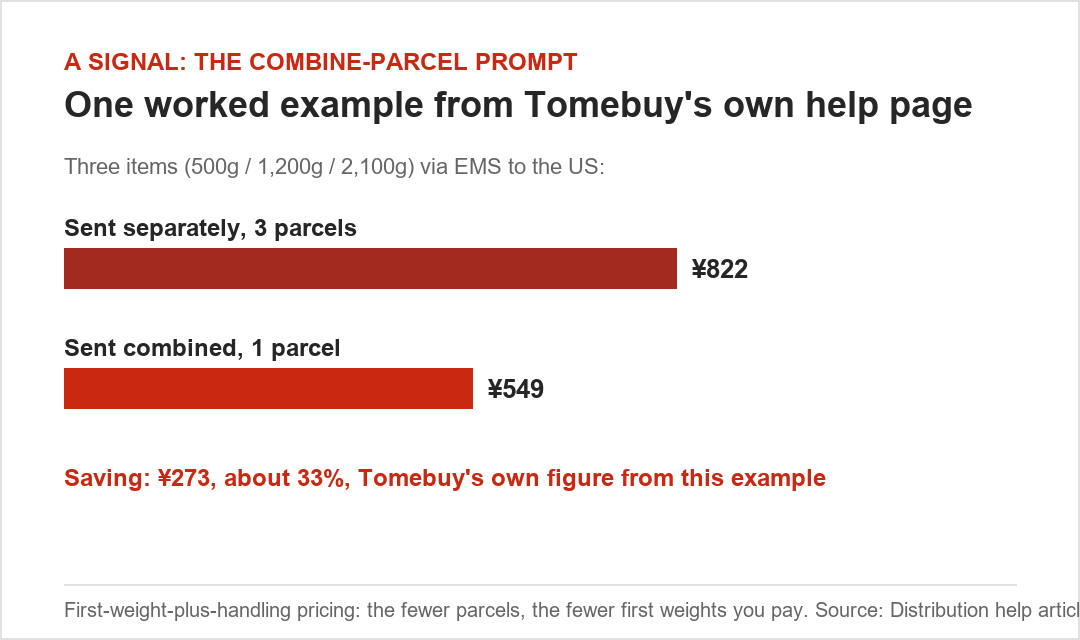
Tomebuy's Distribution help page walks through a real example: three items weighing 500g, 1,200g and 2,100g, shipped via EMS to the United States. Sent as three separate parcels, the first-weight-plus-handling pricing (¥160 first 500g, ¥55 per extra 500g, ¥4 handling) comes to ¥822. Combined into one 3,800g parcel, the same pricing comes to ¥549, a saving of ¥273, about a third of the separate-parcel cost. A second worked example on the Packaging page, in US dollars via a different courier, reports a similar pattern: around $153 sent apart versus about $91 combined for three items. The mechanism is the same either way: every separate parcel is billed its own starting weight, so cutting the parcel count cuts how many times that starting charge gets paid.
Customs, IOSS, and EU VAT
Every parcel carries Tomebuy's own roughly ¥8 customs declaration charge. Separately, import duty at the destination, if your country charges any, is billed to whoever receives the parcel, not to Tomebuy. For European Union destinations, Tomebuy's help centre cites the bloc's July 2021 VAT change: parcels under €150 clear faster through the IOSS system, which Tomebuy says it has registered for. Depending on the shipping line, VAT and any service fee are either collected from the recipient on delivery or charged up front before the parcel ships, so read the line's own note at submission time rather than assuming one pattern applies.
Tomebuy's own notes add that postal channels (standard EMS-type services) generally follow the older delivered-duty-unpaid pattern, where customs contacts the recipient directly for anything owed, while its listed commercial couriers collect VAT and a small service charge through the courier itself before final delivery. Which pattern applies to a given parcel is set by the line chosen at submission, not by the destination country alone.
Duty-free thresholds, by destination
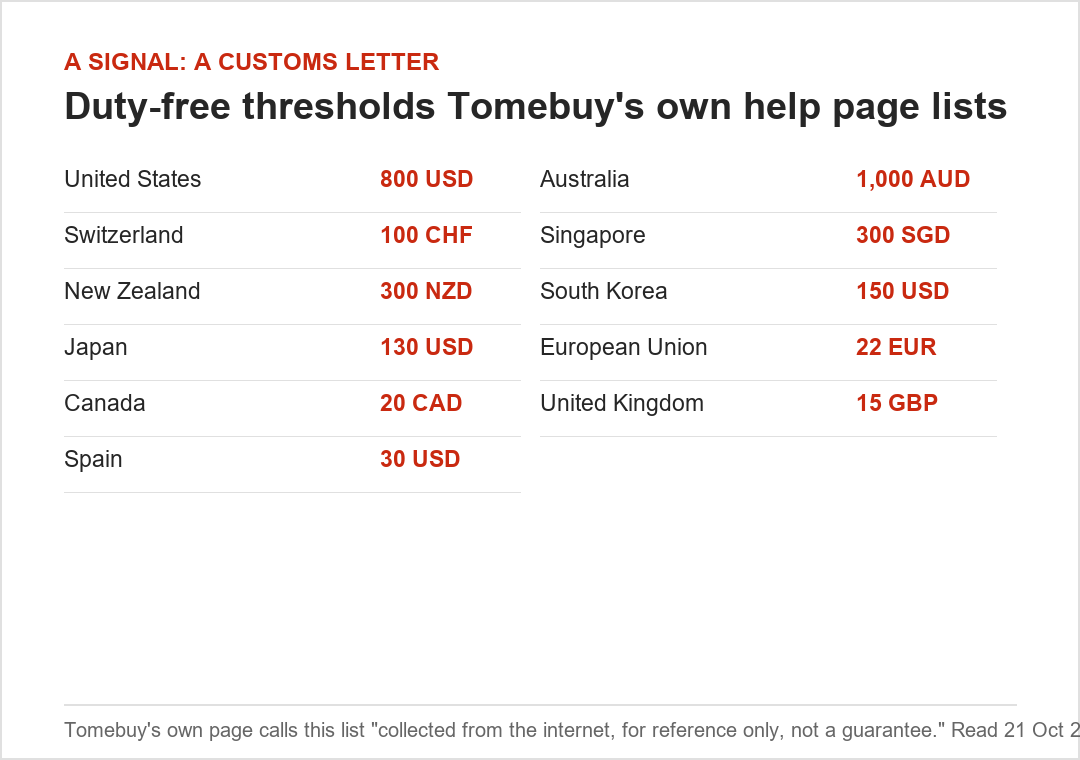
Tomebuy's own help centre lists approximate duty-free declared-value thresholds for eleven countries, with its own caveat attached: the list is “collected from internet data, only for reference, cannot be the standard guidance.” Treat it as a starting point for roughly how your destination behaves, not a guarantee. Tomebuy's own figure for how often a parcel is actually taxed is low, about 0.3 percent of parcels by its own count, though it is explicit that weight, declared value and ordering several of the same item all raise the odds.
What you're actually billed on
Two different weights matter. Product weight is the item as purchased; package weight adds whatever packing material the warehouse uses around it, and freight is billed on package weight, not product weight. A separate volume figure kicks in when a parcel is bulky but light: multiply the box's three dimensions in centimetres, then run that product through a carrier-specific divisor (Tomebuy's own help text lists 5,000, 6,000, 7,000 or 8,000 depending on the line). Whichever of actual weight or volume weight is larger becomes the chargeable figure.
The billing itself happens in two passes. Tomebuy first collects freight based on the weight on file when the item enters the warehouse, then finishes packing within 24 hours of the waybill being submitted. If the packed weight comes in lower than first billed, the difference is refunded to your account balance; if it comes in higher, the difference is deducted from balance before the parcel can ship, so keeping a small buffer in your balance avoids a last-minute hold.
After you submit a parcel
Tomebuy's own Distribution help page states a parcel ships within 24 hours of submission, with the courier pickup itself arranged within two working days, excluding weekends and public holidays, which can push the real figure out if you submit on a Friday.
Customs in most destinations also judges a parcel partly on weight and partly on how many identical items it contains. Tomebuy's own guidance flags parcels over 10kg as more likely to be treated as commercial rather than personal goods, and recommends against a large quantity of the same item in one parcel for the same reason. If several orders of the same thing are stacking up in storage, splitting them across more than one parcel is usually worth the extra first-weight charge from losing some of the consolidation saving above.
Prohibited and restricted items
Tomebuy's Prohibited Items Statement and Distribution help page both list categories it will not ship: weapons and ammunition, counterfeit currency, narcotics and controlled substances, hazardous materials (explosive, flammable, corrosive, radioactive or toxic), live animals aside from a narrow set of packaged exceptions, perishables, and media judged harmful under Chinese law. A second, general postal list adds items that could damage other mail or equipment in transit, and anything the destination country's own customs separately restricts.
Counterfeit and imitation branded goods sit in their own category: Tomebuy's Anti-counterfeiting Policy states plainly that purchasing them is prohibited, and its Prohibited Items Statement repeats the point. If a parcel is judged counterfeit and confiscated at the border, the risk and any resulting loss sits with the recipient, not with Tomebuy.
What the warehouse inspection coversStorage length and the return window