
Other agents
Other agents: what's the same everywhere, and what to compare
A shopping agent is a mechanism, not a brand promise. Here is what stays constant from one to the next, and what actually varies enough to be worth comparing.
The mechanism every agent shares
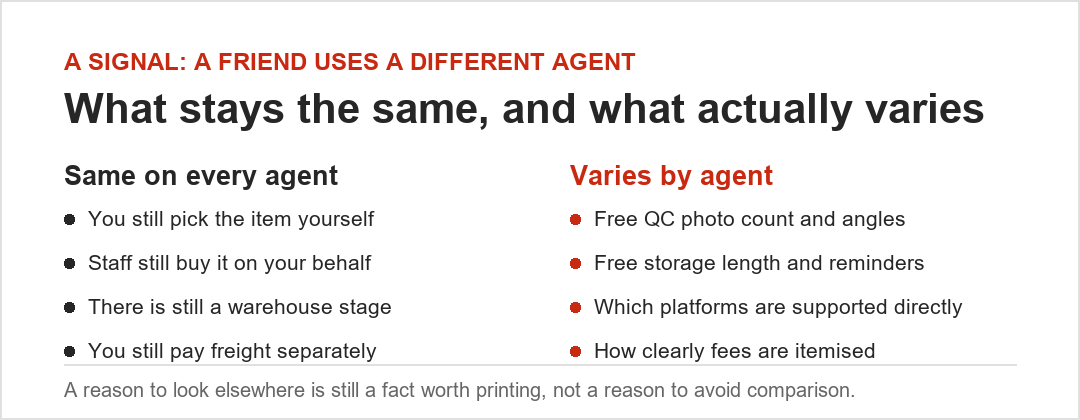
Pull the branding off any agent in this space and four mechanics remain underneath: it lets you point at an item on a marketplace you cannot buy from directly, has staff purchase it on your behalf, receives it at a domestic warehouse, and arranges a separate international shipment once you pay freight. None of that is specific to Tomebuy, and none of it is a reason on its own to prefer one agent over another.
The vocabulary tends to travel with the mechanism too: most agents use some version of an order status, a storage clock, and a chargeable-weight calculation, even where the exact wording differs. Learning Tomebuy's version on Signals transfers reasonably well to a different agent's account pages, even though the specific numbers behind each term will not.
What actually varies
Where agents genuinely differ is in the detail: how many free inspection photos you get and from how many angles, how long free storage runs and how clearly that is stated, which platforms are supported without a manual request form, and how consistently the policy pages agree with each other. Tomebuy's own documentation is a useful case study here, not a flattering one: its storage length and QC photo count each have two or three different published answers, which is exactly the kind of inconsistency worth checking for on any agent before you commit to a first order.
Fee structure is the other place worth a close look. A stated zero handling fee, as Tomebuy publishes, sounds simple, but it only describes one line item; the real comparison between agents is the full stack: item cost, domestic delivery, freight, customs declaration, and whatever optional extras exist. Two agents can both advertise no handling fee and still cost noticeably different amounts once freight and extras are added in.
Reading an agent's own paperwork
Choosing a trustworthy agent comes down to a short, practical test, applied here to Tomebuy itself rather than left abstract: does the site name an operating entity with a real registered address (Tomebuy does, a Hong Kong company, though a second address in its own settings does not match); does it publish a specific anti-counterfeit policy rather than a vague promise (Tomebuy does, explicitly prohibiting the purchase of counterfeit goods); and do its policy pages agree with each other (on storage length and QC photo count, Tomebuy's currently do not). None of these tests is disqualifying on its own. Taken together, they tell you how carefully a given agent's documentation has been maintained, which is a reasonable proxy for how carefully the rest of the operation is run.
Moving your next order elsewhere
None of the mechanics on this site are unique to Tomebuy, so switching agents does not mean relearning the whole process, mainly the specific numbers: a different free-storage length, a different photo count, a different fee structure, and a different set of directly supported platforms. The questions worth asking of any agent before a first order are the same three this edition asks of Tomebuy: what exactly is free, for how long, and what happens once that period runs out. An agent whose own pages cannot answer those three consistently is worth the same scrutiny this edition gives Tomebuy.
What Tomebuy is, and when it suits youThe specific conflicts in Tomebuy's own pages